Badagas of the Blue Mountains…..their unique history, origin, culture, customs, rituals, language and lifestyle !!
Weblog of Wing Commander Bellie Jayaprakash [bjaypee@gmail.com]
Badaga customs and traditions are known for their simplicity, adaptibility and practicality. In this respect a Badaga wedding follows a set of simple rules that has been almost the same over the centuries. But for a minor change here and there, it has been almost the same in all the villages spread across the Nakku Betta or the Nilgiri Hills.
The greatest plus points of a Badaga marriage are that there is NO DOWRY, the wedding always takes place in the boy's (bride groom's) house [or the place of his choice in case of a Kalyana Mandapam /Hotel] and all the wedding expenses including the customary feast [Maduve Hittu] of only vegetarian dishes, are borne by the groom's family.
Incidentally, divorce and remarriges are not uncommon and a widow is not condemned for ever like in most of the Hindu communities and in many cases the widow can marry again even she has children from her earlier marriage.
The best part is the wedding is celebrated by the complete village and the villagers help out in every aspect of the customs and rituals
The greatest plus points of a Badaga marriage are that there is NO DOWRY, the wedding always takes place in the boy's (bride groom's) house [or the place of his choice in case of a Kalyana Mandapam /Hotel] and all the wedding expenses including the customary feast [Maduve Hittu] of only vegetarian dishes, are borne by the groom's family.
Incidentally, divorce and remarriges are not uncommon and a widow is not condemned for ever like in most of the Hindu communities and in many cases the widow can marry again even she has children from her earlier marriage.
Preparation
Whenever a boy comes of age or rather his parents feel that it is time for him to marry (in ancient days a boy would be considered fit to marry at a comparitively young age of say fifteen years. It could be due to also the fact that life expectancy was very low), a lookout for a suitable match is done.
Two important factors that are taken into consideration are the 'MORAY' and the age of the girl. Moray is an unique concept of defining the relationship among Badagas, a concept that has very good scientific reasons and helped in propagation of the community in which marriages do not take place between very close relatives. In a village all are considered as brothers and sisters and hence a marriage cannot take place between a boy and a girl from the same village.
Two important factors that are taken into consideration are the 'MORAY' and the age of the girl. Moray is an unique concept of defining the relationship among Badagas, a concept that has very good scientific reasons and helped in propagation of the community in which marriages do not take place between very close relatives. In a village all are considered as brothers and sisters and hence a marriage cannot take place between a boy and a girl from the same village.
Also, the Badaga Villages [hattis] are grouped into communes apart from the four SEEMEs. In a commune which consists of say Six Villages [called AARU OORU] or Nineteen Villages [Hathombattu Ooru] again every one is a brother or a sister, though the villages may not be physically located close by. For example, Jakkada, Karekorai, Bearhatti, Mel Bikkatti, Keeya Bikkatti, Manjida are part of AARU OORU and hence no marriage can take place among them.
Once the moray is verified and a girl is selected, it is always from the boy's side that they initiate the talk of marriage called 'HENNU KEPUDU' [literaly, asking for the girl]. Boys parents and relatives call on at the girl's house
A typical Badaga wedding is explained with pictures !
This feature contains the photos [taken by Wing Commander Bellie Jayaprakash] on the occasion of SENTHIL, son of Mr.Bogga [Maathi] Ari Gowder and Mrs.Maadhi Ammal at Hubbathalai on 28 May 2007, getting married to SHOBANA of Bearhatty. Ari Gowder, Ari Anna to me, is a very good friend of mine, though he is many years senior to me. He is an excellent painter [Belle Husuva] and has got some special regards for me. Due to an accident of a lorry running over his feet, Ari Gowder is confined to his home these days. He was very particular that I attend his son's wedding and I am glad I could not only attend the happy function but also could record the occasion with these photos.
Bogga Ari Gowder passed away one year after this wedding. May his soul rest in peace


Preparations are on in the groom's house on the pre wedding night, where close relatives converge.

Can there be a wedding without 'AATTA' [dance] ? On the moring of Wedding Day


'Heru' [ a bagful of rice] from the bride's side is being brought to the groom's house. The bride is ceremoniously brought to the groom's house with 'Hey AH OH' hathikkodhu

The bride at the groom's house entrance - 'BAAYILU"


Bride washing her hands and feet


Bride being welcomed by her future mother in law.Mother in law tying the chain - 'ungara mani' [chain with a ring]

Bride and a relative(lady) 'adda bubbadhu'
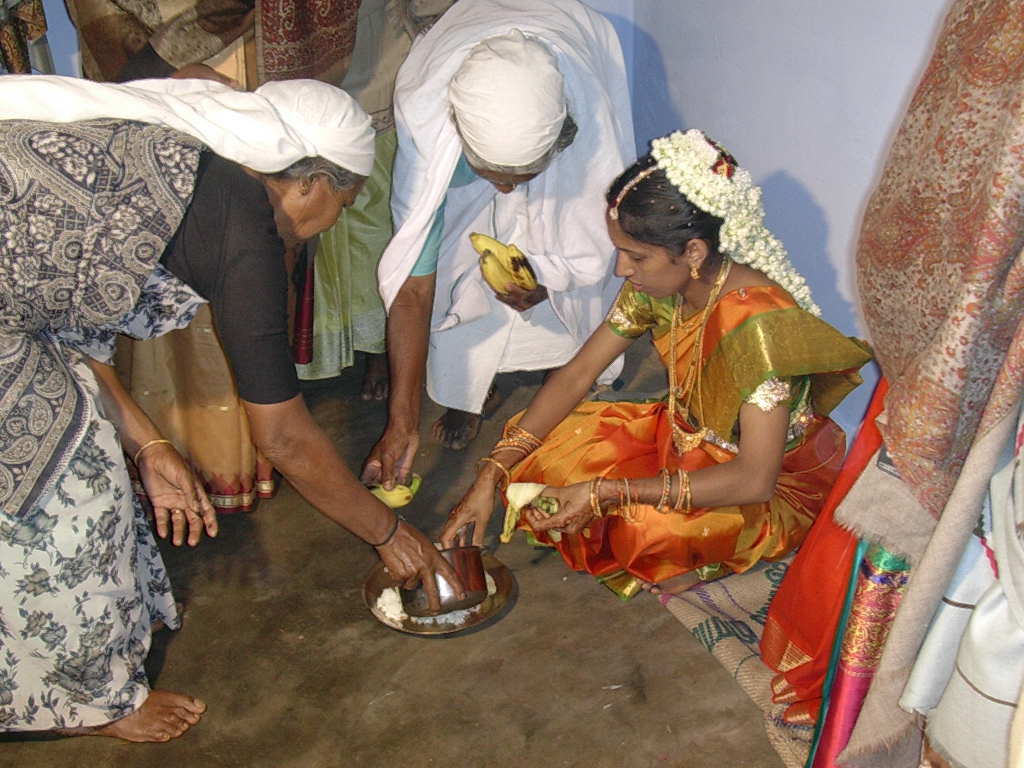

.Bride taking the first meal 'Haalu and Hannu' [milk and banana]


After the first meal the bride throwing away the leftover [echelu neeru].The plate is washed


bride is being taken to the 'halla' [water source & At the halla, the bride cleans the water pot - 'KODA'


water being collected and is brought to the house with two other ladies


The groom who was NOT allowed to see his bride all this time, is getting ready to come to his house from a neighbour's house and being brought to his house


 the couple exchanging the garlands

 the couple seeking the blessings of all and getting ready to go to the temple


at the temple


back home from the temple and with the groom's parents

 groom with a headgear [mandare] and bordered white shawl [seele] and the bride with a white shawl [mundu] getting ready for 'thaali kattodhu' [tying the thaali /mangala sutra]. Groom tying the thaali after asking three times 'thaali kattona mamma? [shall I tie the thaali, uncle?] from the girl's uncle

the couple go to the halla.. ... where the new mat is washed


the relatives and visitors being honoured and .... the newly weds in new modern dress !
~~~~~~~~~~~~~~
This rare photo of Rao Bahadur HB Ari Gowder's wedding was taken about a hundred years back
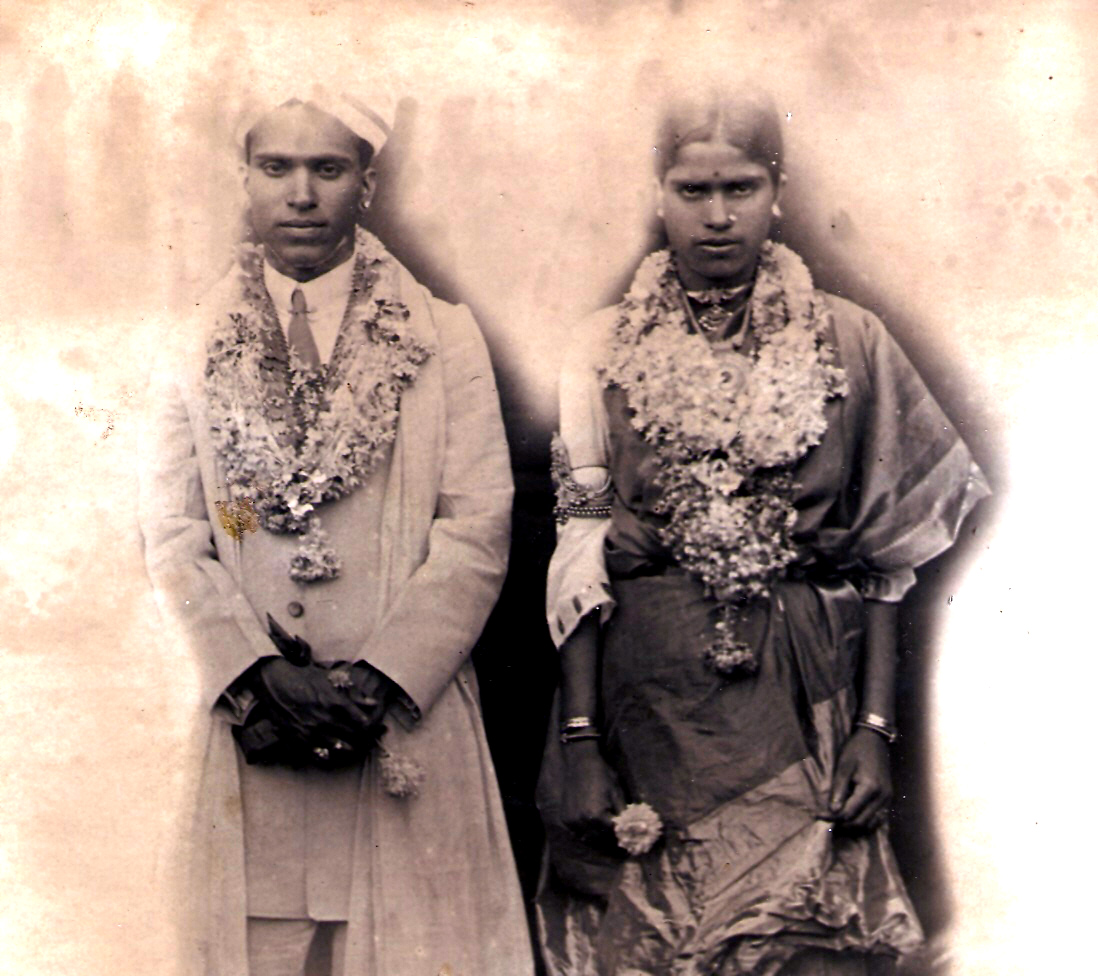
Given below is another Badaga marriage photo taken more than 30 years ago, to be precise, on 2nd June, 1976. The bride is Ari Gowder's grand daughter and the groom, you guessed it, is the author of this weblog

No articles, images and other material in this website can be reproduced without the written permission of
Wing Commander Bellie Jayaprakash B.E.(GCT,Madras Univ).,M.B.A (FMS, Delhi Univ)
belliejayaprakash©2012